
Guide
Choosing a Nursery in Abu Dhabi: the 2026 Rules
Abu Dhabi publishes a rulebook for nurseries that most families never read: minimum adult to child ratios landing by 1 September 2026, capped registration fees, and admission that turns on capacity. What each rule lets you ask for on the visit.

Abu Dhabi gives you something unusual when you are choosing a nursery: a published rulebook you can read before you tour anywhere. ADEK's early education policies set minimum adult to child ratios that institutions adhere to by 1 September 2026, cap registration fees and require them to come off your final bill, and define the narrow circumstances in which a place may be denied. Read those three first, because each one converts into a question a centre can answer on the spot, and the answers separate two nurseries faster than any brochure. Then build your local list from ADEK's own finder and compare what you find on age range, area and approach.
The ratios that arrive on 1 September 2026
This is the change closest at hand. The policies quoted throughout this guide were published in September 2024 as version 1.0, effective from the 2024/25 academic year with full compliance expected from the start of 2025/26, and they are the current text on ADEK's own site as of August 2026. The Early Education Institution policy on child supervision requires institutions to adhere to minimum adult to child ratios "by 1 September 2026", set out by age group:
| Age group | Minimum adult to child ratio |
|---|---|
| 0 to 1 year | 1:3 |
| 1 to 2 years | 1:4 |
| 2 to 3 years | 1:5 |
| 3 to 4 years | 1:8 |
The same policy gives institutions "with a fee classification level in the low-to-mid range" a grace period until 1 September 2028, after which they are subject to these ratios too, and points to Appendix 2 of its own guide for how that classification works. So the question on a visit is which of the two dates applies to the centre, and what the room looks like today.
Three details in that policy make the answer checkable. A minimum of two staff members must always be on the premises when children are present. Volunteers and trainees are not counted in the ratio. And each institution displays its current staff roster, which has to show the daily adult to child ratio for each area, the staff performing non-supervisory tasks, and everyone's scheduled break times. Ask to see the roster for the room your child would be in, at the hour they would be there, and the ratio stops being a claim.
A second ratio sits behind that one and arrives later. The learning and development policy requires one early education educator per key group of up to 16 children at ages one to three and up to 20 children at ages three to four, as of September 2027, with the same low-to-mid grace period running to 1 September 2029. It also provides that an in-training educator counts toward that ratio but is not permitted to lead the key group. Adults in the room and educators leading the group are two different counts under two different policies, so ask both questions separately.
When a place cannot be refused
The admissions policy is six pages, and reading it changes how you approach a waiting list. It requires a "fair, non-discriminatory, and transparent admission process where, other than due to full enrollment, they do not deny admission to any child", and it sets the age window: children "shall be more than 1 day old and less than 4 years of age at the time of enrollment".
Three provisions follow. Children with additional learning needs "shall not be denied a place at their preferred EEI, as long as the EEI has the capacity to accommodate them in the appropriate age group"; every new applicant with identified additional learning needs goes directly to the centre's own Early Education Director, and where the centre cannot accommodate a child it sends an "inability to accommodate" notification to ADEK with the evidence the policy specifies. Vaccination records work the same way: children without complete records "shall be accepted on the condition that the completed necessary vaccinations will be provided to the EEI within the year of enrollment", and where parents convey an intention not to vaccinate, the institution refers the decision to ADEK and the Abu Dhabi Department of Health. Places are offered first come, first served, and where there are more requests than seats a centre may apply admission priorities specified in its own admissions policy, which is worth asking for.
The same policy also covers the thing a shortlist usually turns on. Institutions "shall offer a flexible program of full- or part-time attendance for the children, subject to space availability", and the attendance options are to be communicated on the registration form and the official website. That is a requirement on the options, not a published timetable, so ask each centre for its own hours and days in writing and compare those.
Two smaller provisions save you a second trip. The policy sets out what a centre collects before a child can start, which is worth assembling once and sending to everyone: basic registration details, official documents including Emirates ID, a current passport and visa for child and parents, the birth certificate and photographs, the centre's terms and conditions signed by you, completed health documents including immunisation records, and any assessments or education plans where a child has additional learning needs. And each centre's admission process has to specify whether re-enrollment of existing children runs monthly, termly or annually, which is the detail that tells you how a waiting list behaves once you are on it.
What the fee rules give you before you sign
Where a centre sells days and hours rather than academic years, the same nursery carries several prices depending on the pattern you pick, which is why the number you want is a schedule rather than a figure. Abu Dhabi tells you where that schedule lives and what may be in it. ADEK's Early Education Institution policy on fees requires institutions to secure ADEK fee approvals "before publishing the fee structure on their website for parents' view", and to "only charge the approved fees applicable to the relevant year". Five things in it are worth carrying into every conversation:
Registration fees are capped. The amount "shall be capped at no more than 5% of the payable tuition fees and shall be deducted from the final fee payment", and the fee structure has to state whether it is non-refundable if you decide not to enrol.
Extras need approval, and optional ones need your consent. Institutions must seek ADEK approval before charging fees above tuition and itemise them on invoices, and optional additional fees "shall not be billed to parents without their consent".
The pattern you choose is part of the published terms. The fee policy must list the fee payable "as per the days and timing options" where a centre offers flexible timings and days, so ask for the schedule for your exact pattern rather than a starting figure.
Refund terms are stated in advance, including where there are none. Each institution identifies which fees are non-refundable and states the terms and conditions under which a refund will be offered, in its own fee policy.
So are the consequences of falling behind. The same policy requires each institution to set out its late payment penalties, how many reminders it gives, the grace period after you respond to them, and the notice period after which a child is withdrawn for non-payment. That is the bullet with downside for you, so read it before the pleasant ones.
Increases go through ADEK. Institutions obtain approval for any fee increase and announce it to parents through the process ADEK indicates.
The registration pack is where all of this reaches you, since the fee policy is a document each institution has to include in it. Ask for the pack before you pay anything, not after. Our Dubai nursery guide runs the same exercise for families choosing in Dubai, where a different rulebook applies.
Settling in, and what the first weeks look like
The settling-in policy defines the settling-in period as a process that "may last from 1 to 3 weeks, depending on the child". Plan your return to work around that range rather than around a single start date. Each institution has to explain its process to parents in writing before the child begins, as a step by step breakdown in the parent handbook, and to run a parent induction day. Its policy also has to set out the minimum time a child is expected to stay, the schedule of staggered arrival times, the key person approach, and how you will be kept informed during the settling-in hour. Ask for that document with the registration pack, since two centres a street apart can run this very differently while both complying.
What sits behind the word on the sign
Approach labels do a lot of work on nursery websites, and in Abu Dhabi one of them carries a licensing consequence worth knowing. The child supervision policy authorises institutions to mix age groups "if they are licensed to offer a Montessori curriculum", applying the ratio in line with each age range for the mixed group. A mixed-age room is a Montessori principle, so here it is also a licensing question you can ask about directly. What each of the three common labels is worth as evidence, and what to ask a room leader about it, is in Montessori vs Reggio Emilia vs EYFS.
Behind every label sits the quality assurance and compliance policy. It is aligned to ADEK's Early Education Evaluation Standards and Quality Assurance Framework, and it requires each institution to run a self-evaluation process using tools including ADEK's own, to keep an improvement plan updated at least once a year and available on request by ADEK, and to undergo annual compliance visits "to determine the EEI's compliance with ADEK requirements and all health and safety requirements", plus ad hoc visits at ADEK's discretion, within a set of required inspections the policy describes as relevant for an institution's licence renewal. The same policy says external accreditations and certifications are "not mandatory, but EEIs are highly encouraged to seek relevant accreditations and certifications based on the type of curriculum or learning framework/approach they offer". So where a centre states an accreditation for the approach it advertises, ask which body issued it and look it up with that body.
One requirement sits behind every licensed centre in the emirate, whichever approach is on the sign. The learning and development policy requires institutions to ensure that daily opportunities are provided "to expose all children to the culture and values of the UAE and to learn the Arabic language taught by a native Arabic-speaking EE Educator". Ask how that runs in the room your child would be in.
Building your own list
Start with the regulator. ADEK licenses private nurseries across the emirate, and its nurseries page, which carries no date, says there are "more than 200 private nurseries in Abu Dhabi, offering a range of 4+ curricula tailored for kids aged 0 to 4 years", pointing families to a school finder to locate them. For a dated figure, ADEK's announcement of seven new nurseries on 6 October 2025 put the emirate's total at 233. Use that finder to check what sits near you, then compare the names you collect on the fields a directory does not put side by side.
Price is the one thing you cannot collect from a directory in advance. Nurseries here sell hours rather than academic years, so the number depends on your exact pattern, and the fee structure that matters is the approved one published on each institution's own website under the fee rules above. Read that, then ask for your pattern in writing.
Two examples of what a profile carries, so you know what you are collecting for each name on your list:
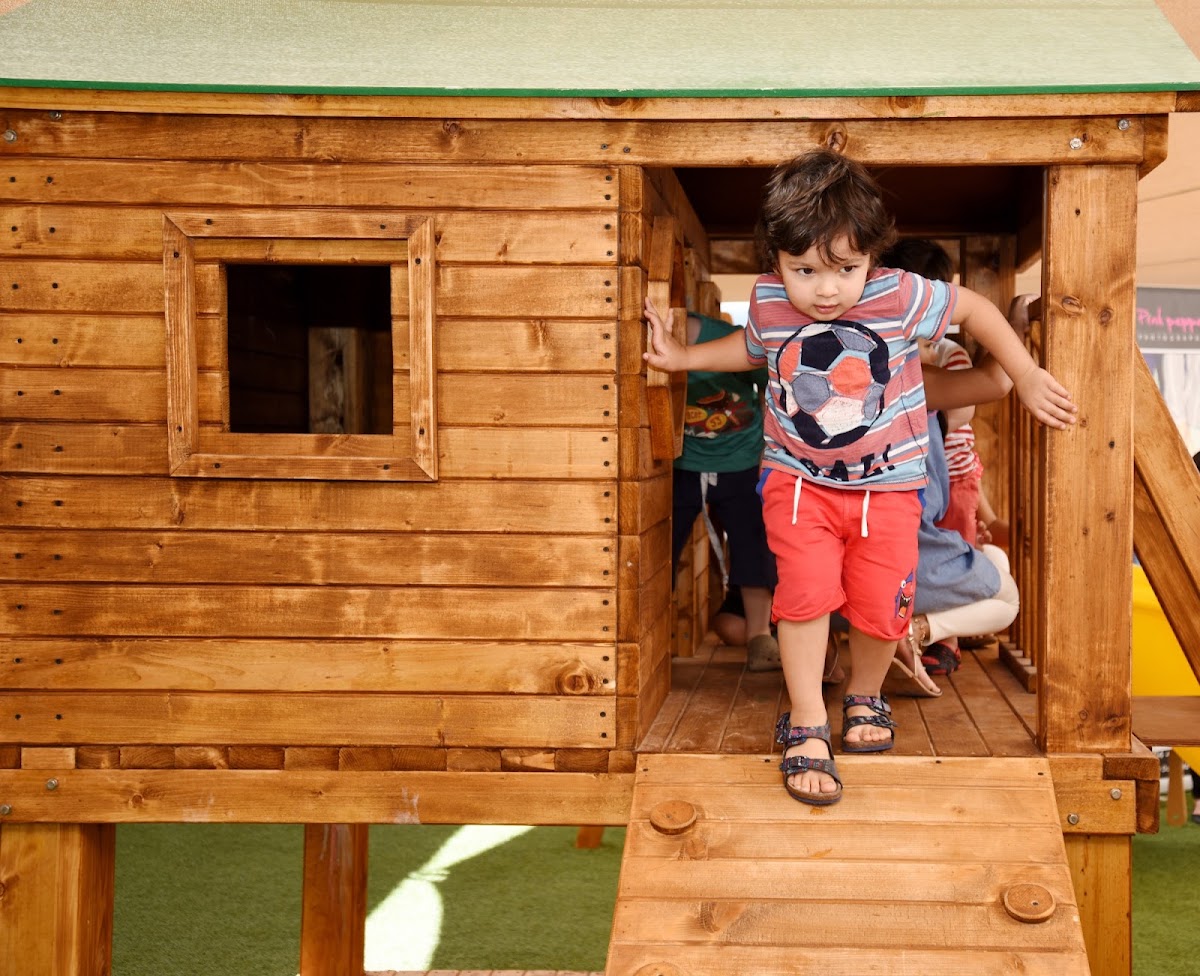
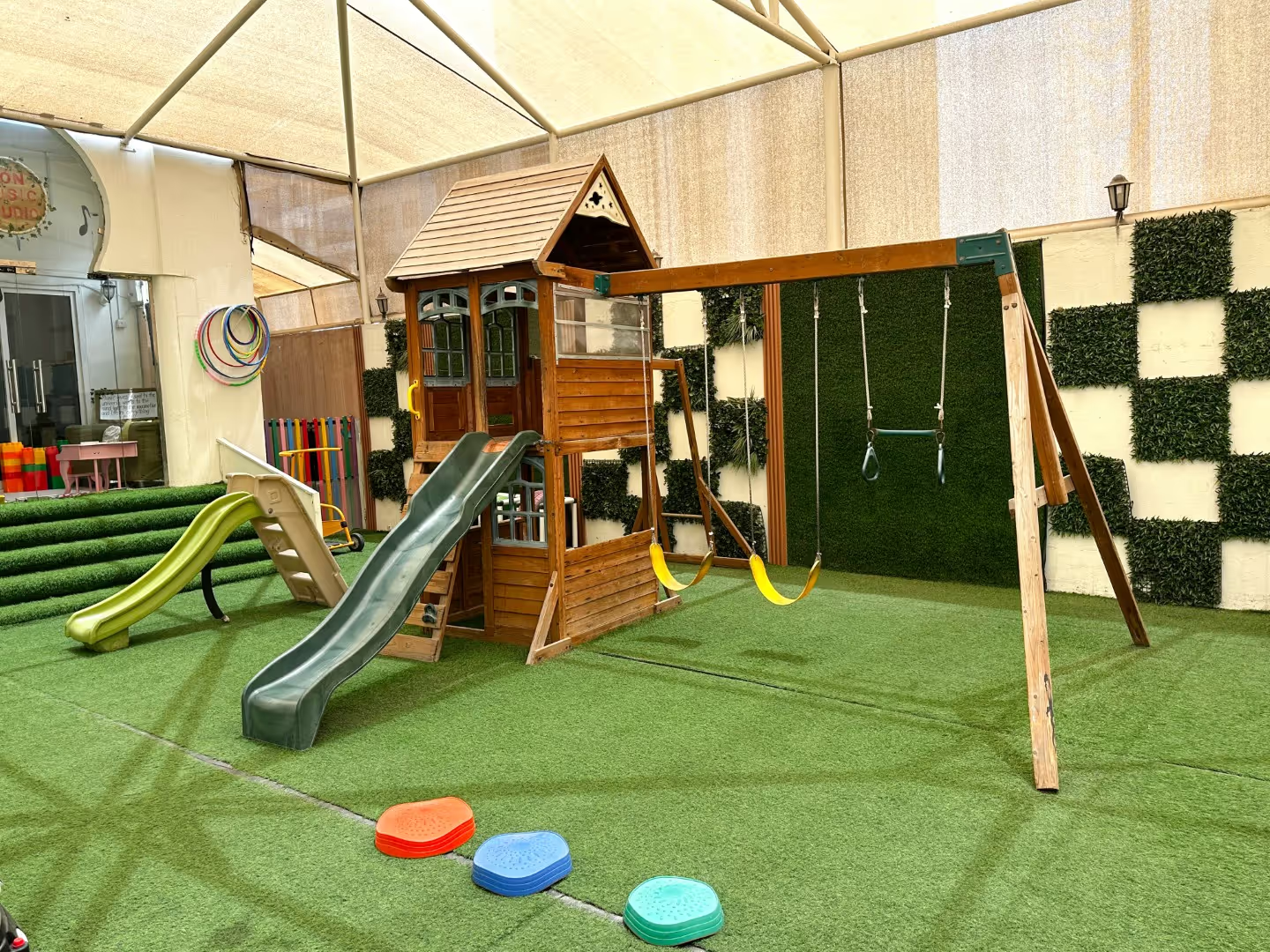

Age is worth checking early rather than late: an infant place is the scarcer thing, and after four the question stops being a nursery one at all, since the year that follows is a school foundation stage class. Worth planning while you are still choosing.
Distance does the rest of the sorting.
Tap Near me on our Abu Dhabi listing and it orders by how far each centre is from where you are standing, which is the axis a working morning runs on; the area filter narrows by neighbourhood, and every nursery we list in the UAE sits behind the same controls.
A method for the shortlist
Fix the pattern you need first: the days, the hours and the start date. Everything after that is a comparison between centres that can serve it.
Build your local list from ADEK's finder, then compare those names on age range, area and approach.
Ask each centre which of the two ratio dates applies to it, and ask to see the displayed roster for your child's room.
Ask for the registration pack, and in it the fee policy, the settling-in policy and the admissions policy. Read the refund terms and the registration fee treatment before you pay a deposit.
Price your exact pattern in writing, with every extra itemised and marked optional or compulsory.
Visit twice, once at drop-off and once mid-morning, and watch how the staff move between the children.
Questions worth asking on the visit
Which adult to child ratio applies in this room today, and which of the two compliance dates does this centre come under?
How many of the adults in the room are early education educators leading the key group, and who would be my child's key person?
What is the total cost of my pattern for a full year, with every additional fee itemised, and which of them are optional?
What does your settling-in schedule look like week by week, what is the minimum time my child stays each day at the start, and what do I pay for those weeks?
What does your admissions policy say about priorities and waiting lists, and where do we sit on it?
Which accreditation, if any, does the centre hold for the approach it advertises, and who issued it?
How do I choose a nursery in Abu Dhabi?
Decide your pattern of days and hours first, then build a local list from ADEK's finder and compare it on age range, area and approach. Use ADEK's early education policies as your question set: the ratio your child's room must meet and the date it applies from, the fee structure for your exact pattern, the refund and registration terms in the registration pack, and the settling-in schedule. Visit twice before you commit.
What is the minimum age for a nursery in Abu Dhabi?
ADEK's admissions policy for early education institutions says children shall be more than one day old and less than four years of age at the time of enrollment, and each institution states the age range its own licence permits. In our listings, 28 of the 33 Abu Dhabi nurseries publish a range that admits a baby under one.
Can a nursery in Abu Dhabi refuse my child?
The admissions policy requires a fair, non-discriminatory and transparent process in which, other than due to full enrollment, a nursery does not deny admission to any child. Children with additional learning needs are not to be denied a place where the institution has capacity in the appropriate age group, and where it cannot accommodate a child it notifies ADEK. Missing vaccination records are not grounds for refusal, on the condition that the outstanding vaccinations are provided within the year of enrollment.
How much do nurseries cost in Abu Dhabi?
It depends on the days and hours you choose, which is why a single figure would tell you little. Under ADEK's fees policy the fee structure is approved before it is published on the institution's website, registration fees are capped at 5 per cent of payable tuition and deducted from the final payment, and additional fees need ADEK approval, with optional ones not billable without your consent. Ask each centre for the schedule for your exact pattern.
What changes for Abu Dhabi nurseries on 1 September 2026?
ADEK's child supervision policy requires minimum adult to child ratios to be adhered to by that date: 1:3 for children under one, 1:4 from one to two, 1:5 from two to three and 1:8 from three to four. Institutions with a fee classification level in the low-to-mid range have a grace period until 1 September 2028, so ask which date applies to the centre you are visiting.
How long does settling in take?
ADEK's settling-in policy describes a process that may last from one to three weeks depending on the child, with a written plan, a parent induction day and staggered arrival times. Ask for the centre's own settling-in policy before you commit to a start date.